
Cinefilium
  • Films
  • Profiles
  • Universities
  • Events
  • About us
United Kingdom

University of the Arts London

MA Television

University degrees: Postgraduate

Course length: 1 year 3 months full time (45 weeks across a four-term model)

MA Television delivers the skills needed to design and make fact-based television. Learn about pitching, budgeting and translating your ideas into practical, hands-on advanced programming.

Why choose this course at London College of Communication

  • A focus on factual programming: The course combines advanced practical training in factual programme making with research-based analysis of the television industry today; its values, its genres, its development processes, its production practices, and the proliferating platforms available to programme makers.
  • A focus on self-employment: The course is designed primarily – but not exclusively – for those who wish to work in, or run, small-to-medium sized production companies, or become freelance producer/directors. The latter provides a large and constant component of the UK production base (and increasingly beyond), but one that is yet to be catered for in many screen schools.
  • Business planning: You’ll produce both a programme (or other moving-image product) and a researched business plan, accompanied by an explanatory narrative, identifying your target market. The programme and plan will be the outcome of guided analysis and research so by graduation you will already have developed a highly viable pitch for your first offer to the television industry.
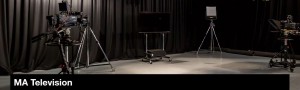
  • The TV studio: Our TV studio is of a very high professional standard, with a new Tricaster mixing desk that allows for a wide range of effects and computer-generated imagery. Mastery of this resource will further distinguish you from the majority of media and film school Master’s-level graduates.
  • Industry contacts: The MA will draw on London College of Communication’s wide range of contacts in the London TV industry to provide visiting lecturers, workshop leaders, critiques and introductions to networks of graduates now working in media in London. It will allow and encourage you to take full advantage of our contacts with the British Film Institute. You will have access to the many specialist cinemas, studios, facilities houses and media events that are features of London’s busy and varied media life.
  • MA Television focuses on the hands-on experience of making television programmes. Working in teams, with access to London College of Communication’s state-of-the-art multi-camera TV studio, you will produce four TV shows, drawing on analysis of contemporary factual genres.

    You’ll learn the key skills needed to make effective programming covering areas such as format, narrative, scripting, camera techniques, lighting, sound, and editing.

    Other units of study will explore the nature of the TV industry, and potential markets for your ideas and programmes.

    What can you expect?

    The TV studio: programmes made for the course will have both location and TV studio contents. Training in the use of the television studio is relatively rare in UK media schools: an omission, given that as much as 70% of TV programming is produced in this way.

    London College of Communication’s TV studio is of a very high professional standard, with a new Tricaster mixing desk that allows for a wide range of effects and computer-generated imagery.

    Mastery of this resource will be a significant asset to graduates of MA Television and will further distinguish them from the great majority of media and film school Master’s-level graduates.

    Multiple perspectives: MA Television approaches the practice of programme-making from complimentary, but interlocking, perspectives, seeing programmes simultaneously as:

    • Directed exercises of the creative imagination.
    • Vectors of ideas, information and understanding.
    • Mechanisms through which social, political and cultural norms are transmitted.
    • Commercial products that must directly or indirectly offer returns on investment.
    • Examples of project management, in which potentially conflicting demands of time, resource, cost and quality must be continually addressed.
    • Adherents to rules of certain formats.

    Collaboration: In the second term, you will develop creative, mutually beneficial collaborations with external partners, for example local charities and NGOs, small businesses, or artists/arts organisations.

    You will produce a programme to a brief you agree with your collaborative partner. You will gain valuable experience of real world contexts, conditions and outcomes of production.

    Media cultures and criticality: The media cultures strand of the MA, which runs through all four terms, will underpin learning and practice through its examination of the key issues surrounding the production, uses and consumption of factual TV programming.

    Their shared basis is the application of theoretical approaches in ways that reinforce and enlarge programme making, and will require you to adopt an analytical, evaluative approach to the shared norms of current practice. This is also an iterative process. Theory and practice operate in parallel, and each will inform the other critically.

    The experience of programme-making will invite you to question the conventions which govern production, for example in the hierarchical nature of production teams, or the extents to which established formats can be amended and developed.

    Mode of Study

    MA Television is in Full Time mode which runs for 45 weeks over 15 months. You will be expected to commit 40 hours per week to study.

    Contact us

    To register your interest and receive information and updates about studying at UAL, please complete this form.

    If you can’t find the information you’re looking for or to ask a question, please contact us.

    Course units

    Each course is divided into units, which are credit-rated. The minimum unit size is 20 credits. The MA course structure involves six units, totalling 180 credits.

    Autumn, Term 1

    Media Cultures 1 (20 credits)

    This unit provides you with an introduction to the critical study of the factual television programme industry; its current practice, its history and its future.

    You will learn an overview of relevant formats and the underlying story development process. You will be assessed on a written piece about a factual television format demonstrating a developed critical awareness and industry insight.

    Production 1 (40 credits)

    You’ll participate in the making of two factual television programmes to an editorial brief, as part of an intensive practical introduction to production techniques.

    You’ll learn about studio practice and discipline in our multi-cam television studio and shooting for location inserts for your studio presentations. You will write an analysis and evaluation of the production context, process and outcome.

    Spring, Term 2

    Collaborative unit (20 credits)

    You will identify, form and develop collaborative working relationships with a range of potential partners or briefs, both collegiate and external.

    You’ll learn about the concept of talent, produce a treatment and proof of concept, draft a budget and production schedule, and make a competitive pitch to industry standards.

    You’ll build an assessed portfolio of work which demonstrates your research and development of collaborative partnerships and reflects critically on the process.

    Media Cultures 2 (20 credits)

    The focus of this unit is factual television programmes as commercial products; how they are branded, who they’re aimed at and what production value means in practice.

    You’ll learn about industry commissioning and pitching practice, the concept of “flow”, audience research and the importance of scheduling. You’ll write a case study of a television programme or series from a practical, industry focused perspective.

    Summer, Term 3

    Research (20 credits)

    In this unit you’ll prepare a coherent pitch, a budget reflecting intended production values, a treatment or script and proof of concept in preparation for your final Major Project pitch to a selected panel.

    You’ll write a programme proposal including numerical data which will set out the narrative, the target audience, and your intended platform. You’ll demonstrate your business case and the research underpinning the programme proposal.

    Major Project – Commencement (60 credits)

    You will form teams to begin pre-production and the production of your group studio-based show and/or location based programme Major Project.

    Autumn, Term 4

    Major Project – Completion

    Major Projects will be completed in post-production and in the delivery of a television pilot or programme. You’ll submit your collaborative group programme, a proposal and business plan that you will be able to take to market.
    Programme specification

    Download course specification (PDF File 209.9 KB)

    Course dates

    Autumn, Term 1

    28 September 2020 – 4 December 2020

    Spring, Term 2

    4 January 2021 – 12 March 2021

    Summer, Term 3

    12 April 2021 – 23 July 2021

    Autumn, Term 4

    4 October 2021 – 10 December 2021

    Learning and teaching methods

    • Lectures
    • Seminars
    • Technical and other workshops
    • Supervised practice
    • Close-reading
    • Critiques of practical outcomes
    • Supervised presentations
    • Guided student-managed learning

    Assessment methods

    • Essays
    • Critical reviews
    • Research plans and outcomes
    • Business plans and accompanying commentaries
    • Evaluation of practical work
    • Presentations

Programs, Courses, Workshops

  • MA 3D Computer Animation
  • MA Animation
  • MA Documentary Film
  • MA FILM
  • MA Games Design
  • MA Screenwriting
  • MA Sound Arts
  • MA Television
  • MA Virtual Reality
  • MA Visual Effects
  • Home
  • About us
  • FAQ
  • Privacy Policy
  • Contact
© 2026 Cinefilium. All Rights Reserved.
We use cookies to ensure that we give you the best experience on our website. If you continue to use this site we will assume that you are happy with it.OKPrivacy policy