University degrees: Postgraduate
Course length: two years (60 credits)
Course city: Los Angeles
The School of Film and Television’s major in Film and Television Production is designed to enable students to express their ideas on the screen-whether that screen is in a theater, at home, or held in one’s hand. Beyond the existing television and theatrical feature landscape, new forms of media empower a single person to be both a worldwide broadcaster and a very selective receiver. Digital technologies have created new ways of working that transcend the traditional distinctions between film and television. The Film and Television Production major combines the best of both of these fields. Students admitted to this rigorous major become quickly immersed in the art of storytelling for the screen. They encounter and study great works of world cinema, both past and present, and ponder the ramifications of the emerging media of the future. They receive expert hands-on training in writing the screenplay, directing actors, cinematography, sound recording and design, and editing. In the process, each student learns about the challenging relationship between art and technique, and how both serve each other. Students learn the practical aspects of mounting a production: budgeting, location scouting, casting, set design and construction, post production, and the importance of safety in all aspects of what they do. Complete premier state of the art equipment and technology are available 24/7-all in service of story. Through teamwork, students learn an appreciation for all of the artists who labor to serve the story, and the camaraderie that comes from working as part of a crew engaged in a large, collaborative creative enterprise. Students also learn to find their individual voices, and express their own points of view, on projects driven by their own creative choices.
In the Film and Television Production program, students gain experience in the crucial leadership role of director/producer/writer, with an emphasis on experiential learning. You can stress narrative or documentary production and are encouraged to explore both. Students are required to shoot three films during their studies, including their thesis film.
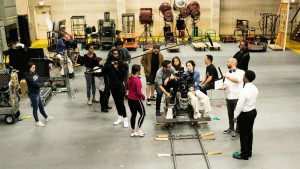
You’ll have ample access to industry-standard equipment and facilities and more opportunities than you can imagine to produce your own work and to crew on the film projects of fellow students. In your first year alone, you’ll deliver 3-5 short narrative or documentary projects in collaboration with future editors, sound designers and other key craftspeople.
The Production M.F.A. emphasizes experiential learning and small class size. This facilitates hundreds of hours on two dedicated production stages and in fully furnished scene and prop shops. And you’ll get plenty of practice on advanced lighting and grip equipment and Red and Canon C300 digital cameras. You’ll expand your production skills working one-on-one with faculty–who are also industry specialists–and learn from visiting instructors who have included visual effects supervisor Richard Taylor (The Hobbit: An Unexpected Journey, District 9) and producer Paula Wagner (Jack Reacher, Mission: Impossible III). The school’s tapeless orientation eases post-production. Your work is saved to a central server so you can call up your project from any computer station at any stage, and then screen your finished film in Mayer Theater.
You’ll come into the Film and Television Production graduate program with some expertise, an idea of your creative identity and a growing professional network. You will exit transformed–and ready to start your career.
Upon completing the program, students majoring in Film and Television Production will know:
Upon completing the program, students majoring in Film and Television Production will value:
Upon completing the program, students majoring in Film and Television Production will be able to:
All courses are 3 units unless specified.
Overall total: 60 units
Fall Semester
Spring Semester
Fall Semester